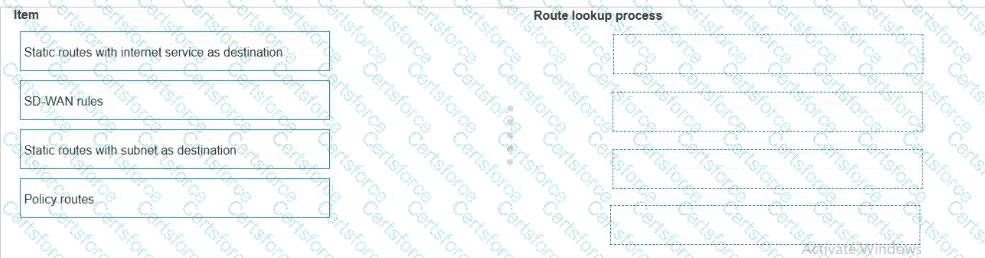
Policy routes
Static routes with Internet Service as destination (ISDB routes)
SD-WAN rules
Static routes with subnet as destination
Exact Extract — FortiOS 8.0.0 Administration Guide
Section: Policy Routes — Order of Precedence, page 633
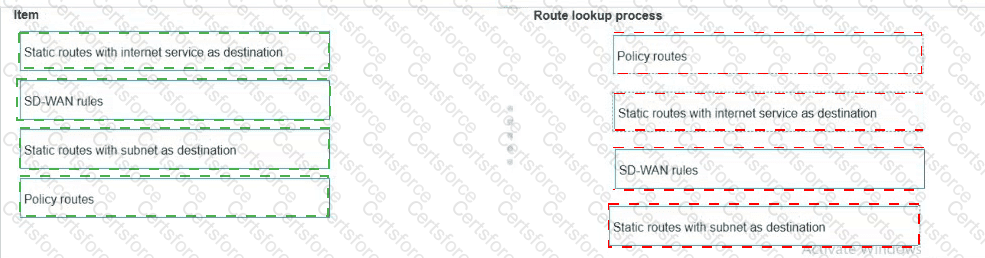
Policy routes can take different forms, including the policy-based, ISDB, and SD-WAN routes.
The documented policy-route precedence is:
Policy-based routes > ISDB routes > SD-WAN routes
Technical Deep Dive
FortiOS applies policy-based routing and conventional routing-table evaluation to determine a packet ' s forwarding path.
Policy routes receive the highest precedence among the specified routing mechanisms. These rules can match characteristics such as source address, destination, service, and incoming interface.
ISDB routes are evaluated next. These are specialized policy routes that use FortiGuard Internet Service Database classifications as destinations instead of conventional subnet-only matching.
SD-WAN rules follow, applying traffic-steering criteria such as application identity, link preference, available bandwidth, and performance SLA conditions.
Finally, conventional static subnet routes , together with other routes in the routing table, provide normal destination-based forwarding when higher-precedence policy routing does not determine the path.
An important qualification is that SD-WAN eligibility commonly depends on a preliminary FIB lookup. Thus, the ordered answer represents the logical forwarding-decision precedence rather than a claim that the FIB is never consulted before SD-WAN evaluation.
The same FortiOS 8.0 routing documentation distinguishes policy-based routes, ISDB routes, SD-WAN rules, and the conventional destination-based routing table.
Fortinet Document Library


Submit