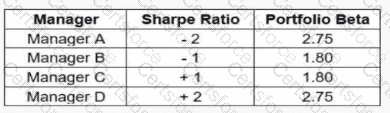
The correct answer is C. Manager D , because the Sharpe ratio is the primary measure used to evaluate risk-adjusted return , which is return earned per unit of total risk . The Investment Funds in Canada curriculum defines the Sharpe ratio as a tool that “ measures how much excess return a portfolio generates relative to the risk taken .” A higher Sharpe ratio indicates superior risk-adjusted performance.
Manager D has the highest Sharpe ratio (+2) among all managers listed, meaning this manager generated the greatest excess return for each unit of risk , regardless of the portfolio’s beta. Although Manager D has a higher beta (2.75), beta measures systematic market risk , not total volatility. The Sharpe ratio already accounts for total risk (standard deviation), making it the preferred comparison metric when the question asks for return for a given level of risk .
Manager C has a positive Sharpe ratio (+1) but lower than Manager D, indicating inferior risk-adjusted performance. Managers A and B both have negative Sharpe ratios , which the CIFC text explains means the portfolio underperformed the risk-free rate , making them clearly inferior choices.
The CIFC curriculum stresses that when comparing managers across different risk profiles, “ the Sharpe ratio is the most appropriate measure .” Since Manager D delivers the highest risk-adjusted return, Option C is the correct and fully CIFC-verified answer.


Submit