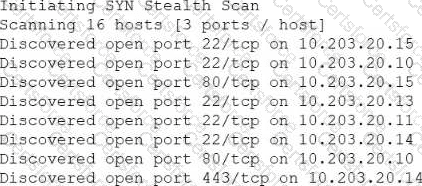
The scan results identify two systems exposing services that permit communications without transport encryption, making B the correct count. The analyst must examine each discovered service rather than merely count open ports, because the security property being evaluated is whether the identified protocol transmits its session or application data without adequate encryption.
Common examples include HTTP instead of HTTPS, Telnet instead of SSH, and legacy FTP rather than protected file-transfer alternatives. The presence of an unencrypted service does not automatically prove that sensitive information is currently being transmitted, but it identifies a configuration that can expose credentials, commands, session content, or application data to interception when used.
The correct vulnerability-management workflow is to map discovered ports to services, determine the security characteristics of those protocols, verify whether encryption is available and enforced, and then prioritize remediation according to asset exposure and business requirements. Where possible, administrators should disable unnecessary cleartext services or replace them with cryptographically protected equivalents.
This question therefore tests interpretation of vulnerability or port-scan output , not simple arithmetic. The two affected systems are those whose discovered services permit cleartext communications.
Study Guide Reference: Vulnerability Management → Scan Result Interpretation → Ports and Protocols → Cleartext Services → Encryption in Transit → Remediation and Secure Configuration.


Submit