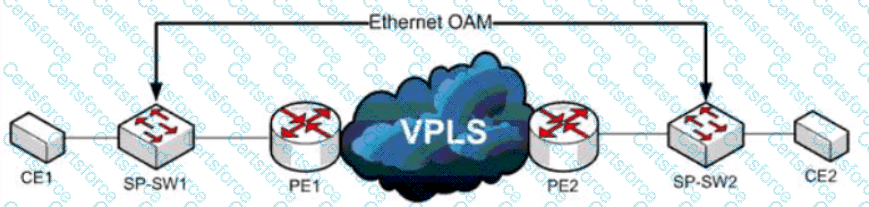
In service provider Ethernet transport environments such as VPLS, Ethernet OAM (Operations, Administration, and Maintenance) is used to provide fault detection, monitoring, and troubleshooting capabilities. The two relevant components here are:
A (Unicast heartbeat messages between MEPs): Maintenance End Points (MEPs) are configured at the edges of the OAM domain (SP-SW1 and SP-SW2). Heartbeat messages can be used to proactively monitor and detect loss of continuity between the endpoints.
B (Enable Connectivity Fault Management): CFM (IEEE 802.1ag) provides end-to-end fault detection, continuity check messages (CCMs), loopback, and link trace mechanisms that operate between MEPs at Layer 2. CFM enables proactive detection of failures and service-level assurance across the provider’s Ethernet segment.
Other options explained:
C: Upward MEPs are not applicable here since these are typically used for customer-facing or hierarchical maintenance domains.
D: E-LMI (Ethernet Local Management Interface) operates between CE and PE for service activation—not applicable for SP-SW to SP-SW fault detection across VPLS.
E: LLDP (Link Layer Discovery Protocol) is for neighbor discovery on directly connected interfaces—not suitable for end-to-end fault detection across a VPLS domain.
This design solution aligns fully with CCDE v3.1 principles for service provider Layer 2 VPN design and Ethernet OAM integration.


Submit