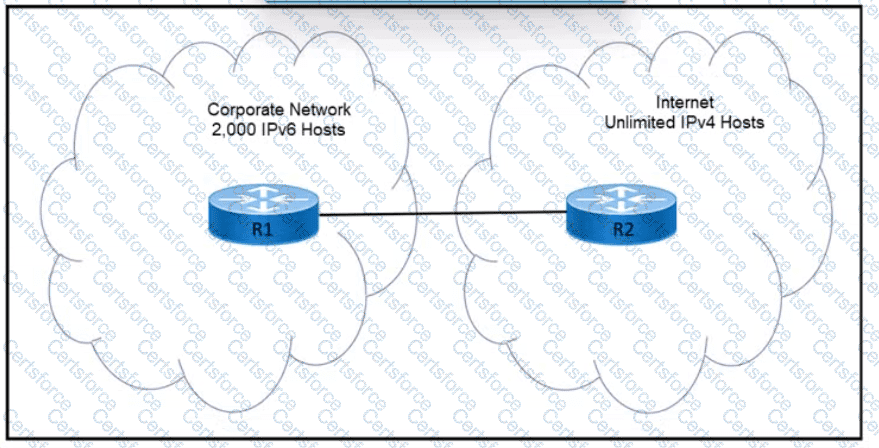
Refer to the exhibit. An engineer must design an address translation solution to provide Internet connectivity for the corporate network. The design Is restricted to the 172.16.168.0/22 subnet. Which solution must the engineer choose?
Stateful NAT64 is the correct translation solution when IPv6-only corporate hosts need Internet connectivity to IPv4 resources using a limited IPv4 address pool. NAT64 translates IPv6 client addresses to IPv4 addresses and maintains state for each session, allowing many IPv6 hosts to share a smaller set of IPv4 addresses through port multiplexing. The design is restricted to the 172.16.168.0/22 subnet, which provides an IPv4 pool that can be used for stateful translation. Stateless NAT64 requires algorithmic one-to-one address mapping and normally needs enough IPv4 address space to represent IPv6 hosts deterministically; it is not suitable when many clients must share a restricted IPv4 block. NAT66 translates IPv6 to IPv6 and does not provide access to IPv4 Internet resources. In a production design, stateful NAT64 is often paired with DNS64 so IPv6-only clients can resolve IPv4-only destinations through synthesized AAAA records. Reference topics: stateful NAT64, DNS64, IPv6-to-IPv4 translation, address conservation, Internet access migration.
Contribute your Thoughts:
Chosen Answer:
This is a voting comment (?). You can switch to a simple comment. It is better to Upvote an existing comment if you don't have anything to add.


Submit