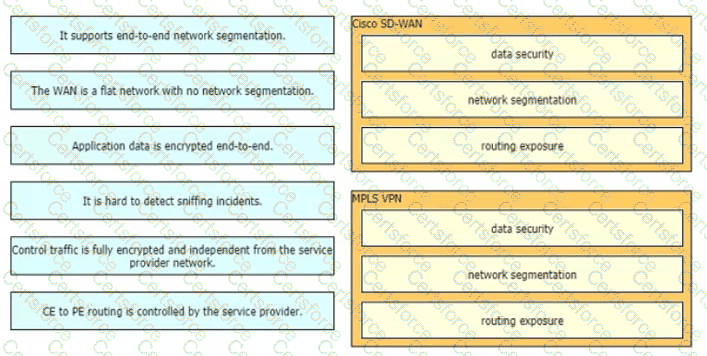
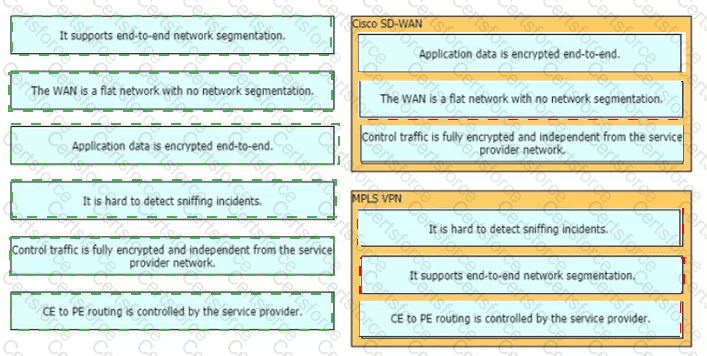
The drag-and-drop mapping separates WAN connectivity technologies by the service characteristics they deliver. Cisco enterprise WAN designs distinguish private WAN options, such as MPLS Layer 3 VPN, Ethernet WAN, VPLS, and VPWS, from Internet-based options such as broadband, LTE, and VPN overlays. Layer 3 MPLS VPN gives the provider responsibility for routing between customer sites and is commonly used when private any-to-any routing, QoS treatment, and segmentation are required. Layer 2 services such as VPWS and VPLS extend customer Layer 2 adjacency across a provider network; VPWS is point-to-point, while VPLS is multipoint. Internet and cellular links are typically lower-cost and fast to deploy, but they require overlay security, such as IPsec, DMVPN, or SD-WAN encryption, when used for enterprise private traffic. The selected mapping therefore aligns each description with the WAN category that actually provides that behavior. In design work, the architect must compare latency, resiliency, SLA, QoS preservation, encryption requirements, routing control, and operational ownership before selecting the WAN type. Reference topics: enterprise WAN connectivity, MPLS VPN, VPLS, VPWS, Internet VPN, cellular backup.


Submit