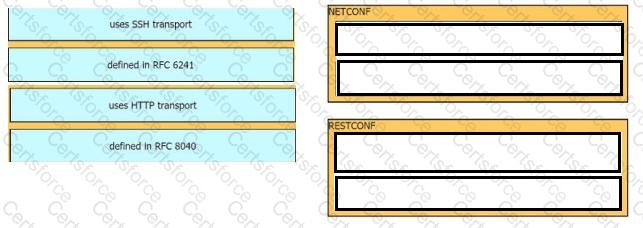
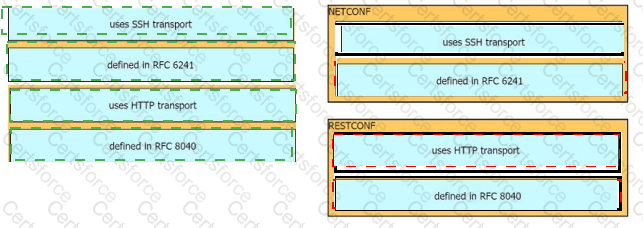
The configuration-protocol mapping distinguishes NETCONF and RESTCONF behavior in model-driven programmability. NETCONF is an XML-based network configuration protocol that runs over a secure transport such as SSH and supports structured operations such as get-config, edit-config, lock, unlock, commit, and datastore manipulation. It is well suited to transactional configuration workflows where candidate and running datastores are supported. RESTCONF exposes YANG-modeled data through a REST-style interface over HTTP or HTTPS, using familiar methods such as GET, POST, PUT, PATCH, and DELETE. It can encode data in XML or JSON depending on headers and implementation. Both protocols use YANG models to define the structure and semantics of configuration and operational data, but they differ in transport style, operation model, and tooling. The selected mapping therefore places NETCONF characteristics with the protocol that provides RPC-style operations and datastore handling, while RESTCONF receives HTTP method and URI-based characteristics. In design, the choice depends on controller support, device operating system, required transaction semantics, security policy, and developer tooling. Reference topics: NETCONF, RESTCONF, YANG, datastores, XML and JSON encoding.
Contribute your Thoughts:
Chosen Answer:
This is a voting comment (?). You can switch to a simple comment. It is better to Upvote an existing comment if you don't have anything to add.


Submit