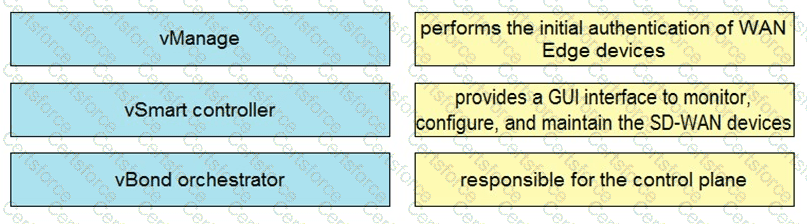
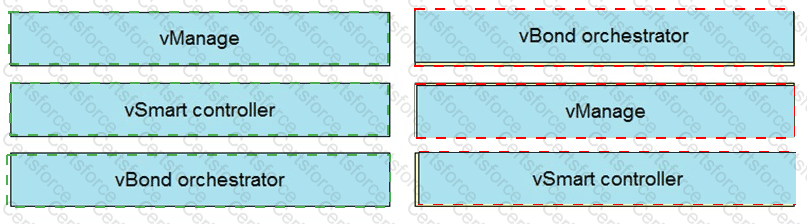
The Cisco SD-WAN architecture mapping follows the standard controller and edge roles. WAN Edge devices are the data-plane routers that forward user traffic, build secure IPsec tunnels, participate in local routing, and apply QoS and security policies at sites. vSmart controllers provide the centralized control plane. They maintain overlay routing and policy information and distribute it to WAN Edge routers through OMP. vBond orchestrators provide the initial orchestration function, including device authentication assistance, control connection coordination, and NAT traversal support so devices can join the overlay. Depending on the exact drag-and-drop labels in the exhibit, the selected mapping assigns each element to its architectural function rather than to a deployment location. The important design principle is that vManage, vSmart, vBond, and WAN Edge have separate responsibilities and should be scaled and secured accordingly. vManage manages and monitors, vSmart controls routing and policy, vBond helps devices join and traverse NAT, and WAN Edge forwards traffic. Reference topics: Cisco SD-WAN architecture, WAN Edge, vSmart, vBond, OMP, control and data plane separation.
Contribute your Thoughts:
Chosen Answer:
This is a voting comment (?). You can switch to a simple comment. It is better to Upvote an existing comment if you don't have anything to add.


Submit