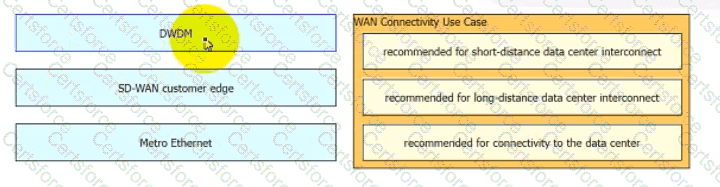
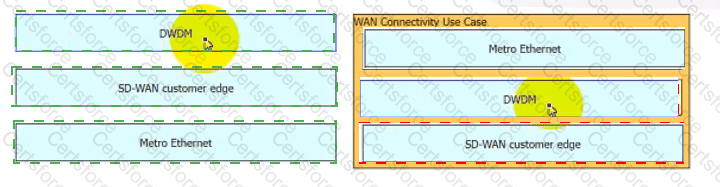
The WAN connectivity mapping distinguishes private, public, and overlay connectivity use cases. Enterprise WAN design normally selects the transport according to the required security, availability, latency, cost, and operational control. MPLS Layer 3 VPN is commonly used when the enterprise needs private routed WAN service with provider-managed segmentation and predictable QoS behavior. Internet VPN designs are used when cost, rapid deployment, or broadband availability is more important, with IPsec or SD-WAN providing encryption and overlay control. Layer 2 services such as VPWS or VPLS are selected when the customer requires Ethernet adjacency, VLAN transport, or transparent LAN-like connectivity across sites. The drag-and-drop answer preserves those distinctions by matching each WAN type to the use case it is designed to support. A professional WAN architecture can combine these transports in a hybrid model, but the design must still identify which service carries private routing, which carries encrypted overlay traffic, and which provides Layer 2 extension. Reference topics: WAN transport selection, MPLS L3VPN, Internet VPN, Metro Ethernet, VPWS, VPLS, hybrid WAN design.
Contribute your Thoughts:
Chosen Answer:
This is a voting comment (?). You can switch to a simple comment. It is better to Upvote an existing comment if you don't have anything to add.


Submit