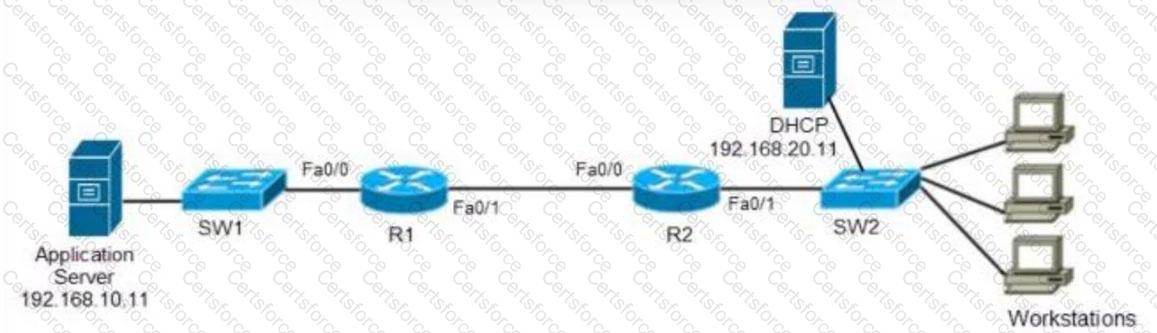
IP directed broadcast must be enabled on the last Layer 3 device connected to the destination client subnet, which is R2 in the exhibit. Wake-on-LAN uses a magic packet that must reach sleeping hosts on the target LAN. Because sleeping clients often do not have an active IP stack or ARP entry, the WoL packet is commonly sent as a directed broadcast toward the target subnet. Routers forward the packet as a unicast until it reaches the destination subnet, where the last-hop router converts it into a Layer 2 broadcast if directed broadcasts are permitted. Cisco disables directed broadcasts by default on many platforms because of historical amplification-attack risks, so the design should enable it only where needed and protect it with ACLs. Spanning-tree UplinkFast is unrelated to delivering WoL packets; it improves STP convergence on access switches. Enabling directed broadcasts on the wrong router would not place the magic packet onto the client VLAN. Therefore, R2, the last-hop router toward the target WoL clients, is the correct location. Reference topics: Wake-on-LAN, IP directed broadcast, last-hop router behavior, subnet broadcast forwarding, ACL protection.
Contribute your Thoughts:
Chosen Answer:
This is a voting comment (?). You can switch to a simple comment. It is better to Upvote an existing comment if you don't have anything to add.


Submit