Anthropic Claude Certified Architect - Professional CCAR-P Question # 27 Topic 3 Discussion
CCAR-P Exam Topic 3 Question 27 Discussion:
Question #: 27
Topic #: 3
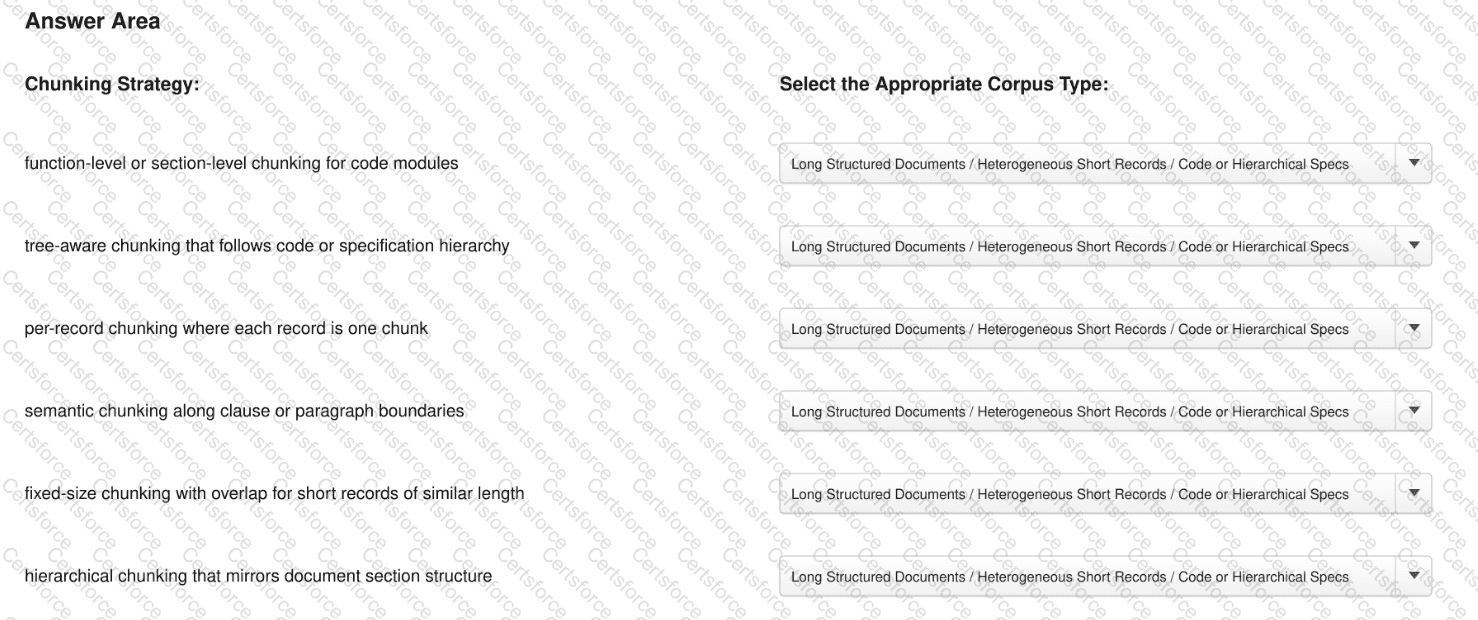
You are classifying chunking strategies by the corpus type each is best suited to.
For each chunking strategy, select the appropriate corpus type: “Long Structured Documents,” “Heterogeneous Short Records,” or “Code or Hierarchical Specifications.”
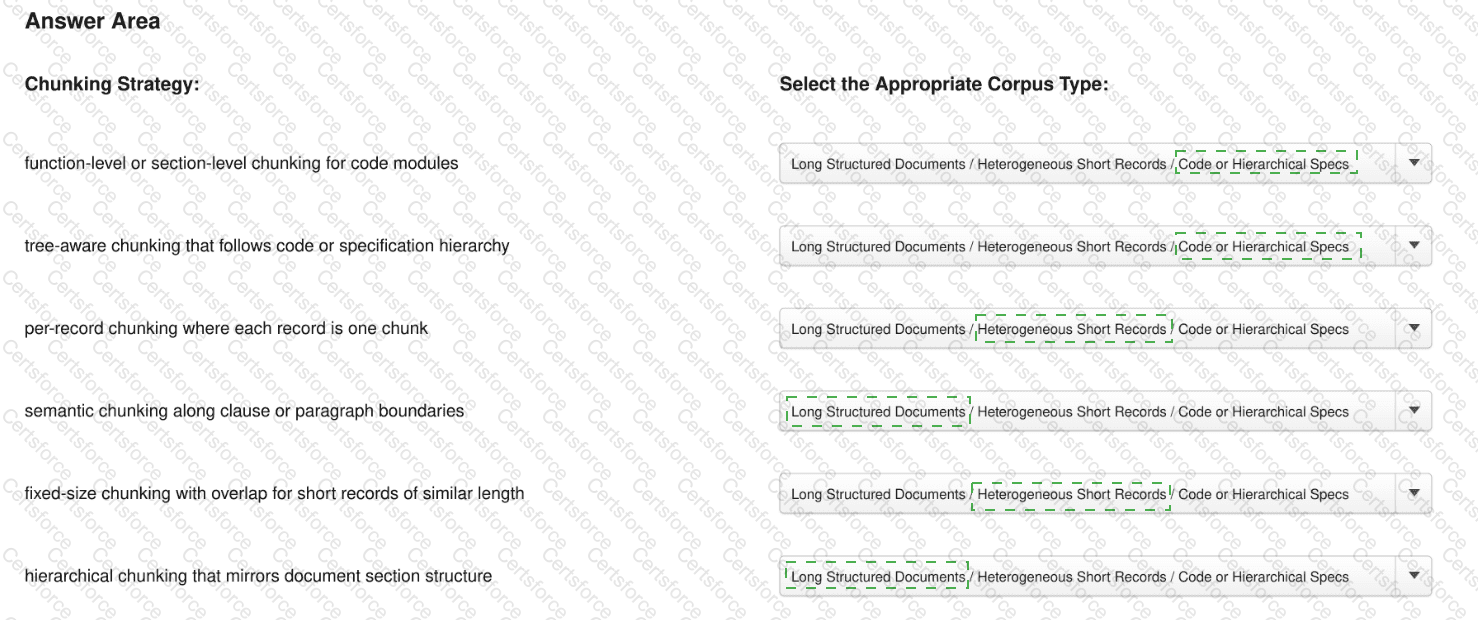
Function-level or section-level chunking for code modules — Code or Hierarchical Specifications
Tree-aware chunking that follows code or specification hierarchy — Code or Hierarchical Specifications
Per-record chunking where each record is one chunk — Heterogeneous Short Records
Semantic chunking along clause or paragraph boundaries — Long Structured Documents
Fixed-size chunking with overlap for short records of similar length — Heterogeneous Short Records
Hierarchical chunking that mirrors document section structure — Long Structured Documents
Chunking must preserve the structural unit that carries meaning in the source corpus. Code and hierarchical specifications are best divided at function, module, class, or tree boundaries because arbitrary token cuts can separate definitions from their implementation or parent context. Heterogeneous short-record collections should generally preserve each record as an independent chunk. Fixed-size overlapping chunks are also effective when records have broadly similar lengths and lack meaningful internal hierarchy. Long structured documents benefit from semantic boundaries such as clauses and paragraphs, while hierarchical chunking preserves relationships among sections, subsections, and parent headings. Anthropic notes that chunk size, boundaries, and overlap materially affect retrieval performance; therefore, one universal chunking method is inappropriate. Anthropic Contextual Retrieval
Contribute your Thoughts:
Chosen Answer:
This is a voting comment (?). You can switch to a simple comment. It is better to Upvote an existing comment if you don't have anything to add.


Submit