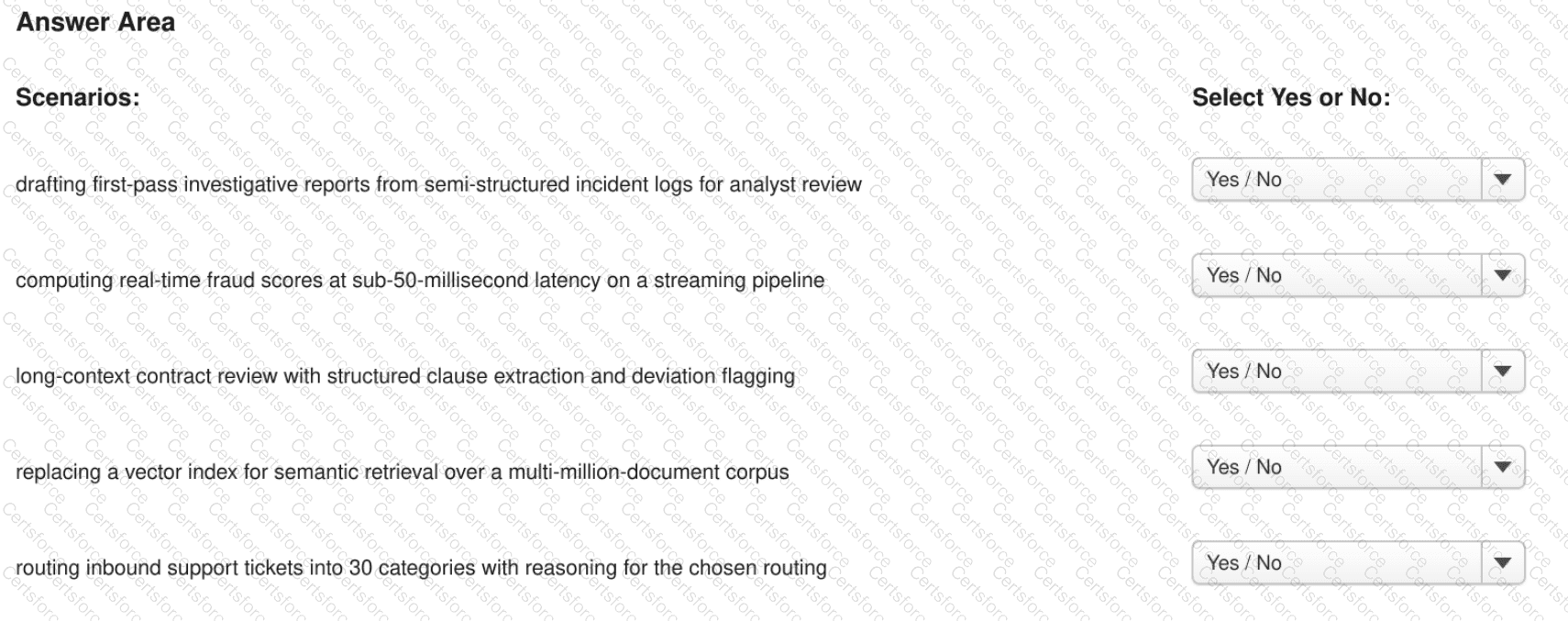
Drafting first-pass investigative reports from semi-structured incident logs for analyst review — Yes
Computing real-time fraud scores at sub-50-millisecond latency on a streaming pipeline — No
Long-context contract review with structured clause extraction and deviation flagging — Yes
Replacing a vector index for semantic retrieval over a multi-million-document corpus — No
Routing inbound support tickets into 30 categories with reasoning for the selected route — Yes
Claude is well suited to language-intensive analysis, summarization, extraction, classification, and drafting. Investigative-report drafting, contract analysis, and support-ticket routing all require interpretation of unstructured or semi-structured language and can incorporate human review. A sub-50-millisecond fraud-scoring path requires deterministic, specialized real-time processing and should not place LLM inference on the critical path. Claude also does not replace the retrieval index used to search millions of documents; it consumes the results produced by that infrastructure. The correct architectural decision separates tasks requiring semantic language reasoning from deterministic computation and information-retrieval infrastructure. Model selection and evaluation must then confirm that the chosen Claude model satisfies quality, latency, and cost requirements.
Contribute your Thoughts:
Chosen Answer:
This is a voting comment (?). You can switch to a simple comment. It is better to Upvote an existing comment if you don't have anything to add.



Submit